 In this new essay published today at The Church Life Journal, I look at St. Hildegard of Bingen's views on the origins of sexual abuse and the universal #MeToo moment. She notices precisely the ways in which the abuse of power distorts our ability to know and understand reality, and thus distorts our relationships with each other and with God. Her solution lies in the redemption of human nature through Christ's humility.
About Me

- Nathaniel M. Campbell
- I am a medievalist, a social studies teacher at Knox Central High School, and an adjunct instructor in history at Union Commonwealth University. My research includes medieval theologies of history, text/image relationships in visionary and mystical texts, and the writings of the twelfth-century Doctor of the Church, St. Hildegard of Bingen. I am also a translator of medieval Latin and German texts, especially as relate to my research. My translation of Hildegard's Book of Divine Works is available from Catholic University of America Press here. I completed a Master's in Medieval Studies at the University of Notre Dame in 2010, a Fulbright Fellowship in Germany in 2008, and a B.A. in Classics and German at Boston College in 2007.
Friday, August 19, 2022
"Sexual Abuse and the Shadows of the Fall"
In this new essay published today at The Church Life Journal, I look at St. Hildegard of Bingen's views on the origins of sexual abuse and the universal #MeToo moment. She notices precisely the ways in which the abuse of power distorts our ability to know and understand reality, and thus distorts our relationships with each other and with God. Her solution lies in the redemption of human nature through Christ's humility.

Friday, April 22, 2022
“Hildegard of Bingen’s Lament for the Environmental Crisis Caused by Human Sin”

For Earth Day, I've got an extended look at the integrated ecological vision of St. Hildegard of Bingen up over at the Church Life Journal of the McGrath Institute for Church Life at the University of Notre Dame--check it out!
Saturday, December 25, 2021
“Let the heavens be glad and let the earth rejoice!” (Ps 95[96].11)
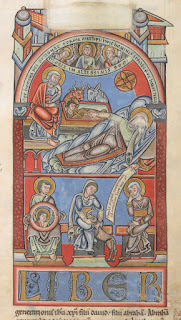 |
| The Nativity of Christ, from the Floreffe Bible, British Library, Add MS 17738, fol. 168r (ca. 1170, Belgium) |
From the Speculum Ecclesiae of Honorius Augustodunensis (early 12th cen.)[1]
Let the heavens be glad and let the earth rejoice! Let the mountains break into songs of praise, for the Lord has comforted his people and will have mercy on his poor (Ps 95[96].11 / Is 49.13).[2] It is right that the heavens are bid to be glad today, for today they have gained the illumination of new light and new joy. Today indeed heavens’ King has willed to visit the earth with his presence and to restore through humans the loss incurred in heaven by the angels’ fall.[3] So at once the heavens have shown their cheerful joy to the world by sending forth a shining star in honor for their King. It is also right to urge the earth to rejoice today, for the Truth that sprung up from the earth (Ps 84.12[85.11]) has come today to free her from the curse and to unite humankind, born from the earth, with the angels in heaven. The earth has made her great exultation known to the world today by pouring forth from her womb a spring of oil for her God, who is born from her bosom, and offering it to those who look in wonder [4] The mountains, too, are urged to break into song in praise of God.[5] The mountains are the patriarchs and prophets, who transcended human merits by their holy way of life like mountains that rose high above the plains of the earth. Today they have broken into song in praise of God, for what the patriarchs once foretold in figures and the prophets in Scripture, they rejoice today to see fulfilled—that the people of the Gentiles who walked in the darkness of ignorance have seen today the great light of God’s eternal Wisdom (Is 9.2). And on those who dwell in the land of the shadow of death—that is, hell—light has risen (Is 9.2): Christ is born, the splendor of the everlasting Father;[6] after coming down for them and snatching them from the darkness, he drew them towards eternal light.
Monday, November 01, 2021
Now published: “Picturing Hildegard of Bingen’s Sight” in The Cambridge Companion to Hildegard of Bingen
Nathaniel M. Campbell, “Picturing Hildegard of Bingen’s Sight: Illuminating Her Visions.” Ch. 12 in The Cambridge Companion to Hildegard of Bingen, ed. Jennifer Bain. Cambridge University Press, 2021, pp. 257-279; access online here.
Summary
This chapter explores the development and purpose of the illustrations in two manuscripts of Hildegard of Bingen’s works: one designed by Hildegard (the Rupertsberg Scivias), the other designed by a later generation of her monastery’s nuns (the Lucca Liber divinorum operum). An overview of her visionary experiences demonstrates the prophetic mission of their detailed images to communicate theological truths. I argue that Hildegard designed the Scivias images to aid that communication and provide visual exegesis of her visions, serving as a teaching tool to guide the reader through the manuscript. The next generation of nuns followed Hildegard’s impulse to illustrate her visions with the later Liber divinorum operum manuscript, but its famous cosmological diagram diverges from the text because the designer did not understand its meaning. The chapter closes with an assessment of the very limited influence of Hildegard’s illustrations in the later Middle Ages, with one story from the preaching of Johannes Tauler demonstrating their liability to reinterpretation.
Friday, September 17, 2021
O hortulana sapiens: A Chronogram for the Feast of St. Hildegard of Bingen
 |
| A statue of St. Hildegard in a garden. Source: The Abbey of the St. Hildegard. |
VIsIones tVae Verba VtILIa
sICVt herbas bonas
nobIs proferVnt:
ora pro frVCtVosItate nostra,
Vt oDor VIrtVtVM
a spIrItV sanCto qVasI a faVo pVro effVsVs
In nobIs InVenIatVr.
O gifted gardener,
your visions bring forth
helpful words for us
like wholesome herbs:
pray for our fruitfulness,
that the aroma of the virtues,
poured forth by the Holy Spirit as from a crystal honeycomb,
might be found within us.
Monday, November 09, 2020
St. Hildegard of Bingen on the Interconnectedness of Creation
I gave the following talk as part of the 2020 “St. Hildegard Speaks” virtual pilgrimage in September:
You can find my translation of Hildegard’s Book of Divine Works from The Catholic University of America Press here or on Amazon here.
You can find the 2020 Chronogram from the end of the talk here.
Thursday, September 17, 2020
O luce viventi coronata: A Chronogram for the Feast of St. Hildegard of Bingen
 |
| Hildegard beholds the universe. Liber Divinorum Operum 1.4 (detail from Lucca, MS 1942, fol. 38r) |
CVIVs VoX qVasI tonItrVI
nos De LangVore nostro
In saLVteM roborat:
ora pro nobIs
et pro aegra orbIs aetate nostrI.
O one crowned with the Living Light,
whose voice as of thunder
strengthens us from our weakness
into health:
pray for us
and for this ailing age of our world.
Sunday, May 31, 2020
“By the word of the Lord the heavens were established, and all their power by the spirit of his mouth.” (Ps 32[33].6)
A Sermon for Pentecost
 |
| Pentecost From British Library, MS Egerton 809, fol. 35v (Gospel Lectionary, early 12th cen., Germany) |
From the Speculum Ecclesiae of Honorius Augustodunensis (early 12th-cen.)[1]
By the word of the Lord the heavens were established, and all their power by the spirit of his mouth (Ps 32[33].6).[2] Through the Son, who is the Word of God, not only the heavens but all things were created from nothing, and so that they would not be again melted into nothing, they were confirmed by that same Word and all their power furnished by the spirit of his mouth. The angels, too, are called “heavens” who, when the others fell, were confirmed in divine love through the Word and decked out by his spirit with all power.[3] So it is written, The Spirit of God has adorned the heavens (Job 26.13), for he graced both the heavens with the stars and the angels with the virtues.
Thursday, May 21, 2020
“The sun was lifted up, and the moon stood fixed in its order.” (Hbk 3.11)

|
| The Ascension of Christ 13th-c. apse window, Lyons Cathedral (Image: Wikipedia) |

A Sermon for the Ascension of the Lord
From the Speculum Ecclesiae of Honorius Augustodunensis (early 12th cen.)[1]
The sun was lifted up, and the moon stood fixed in its order (Hbk 3.11).[2] Christ is the eternal sun, by which all the angels’ choirs are enlightened; he is the true light, by which all souls are enlightened (Jn 1.9). While hidden here beneath the cloud of the flesh, he is surrounded by the gloom of our fragility—but at last he surfaced from the darkness of hell and today is lifted gloriously up above the stars and exalted above all the angels’ dignities, the Lord of Majesty at the right hand of the Father. The moon or Church, enlightened by him, stood fixed in her order,[3] as with the apostles she watched him ascend the heavens. The apostles indeed formed the Church’s order as they established for her the order of living rightly and instructed her in how to direct her course according to the Sun of righteousness (Mal 4.6). O how splendid these horns the newborn moon has extended today, as the sun rising high poured into it the brilliance of eternal splendor! O how clear her visage, as she stood fixed in her order, watching with the apostolic choir—who formed her order—and with the Virgin Mother of God—who served as her type—as her flesh penetrated the outer heavens with her head, that is, with her Redeemer, with her Bridegroom, with her God! O what happiness mounts up today in heaven for the angels, as the Son of God, who was directed from the palace to the prison on behalf of a servant—indeed from his homeland into exile, an exile on behalf of an exile—as he returns today triumphantly to the Father’s kingdom! So too this is called the day of God’s triumph, when the singular Conqueror of death is glorified as the Author of life with hymns of praise by the Senate of the heavenly Court.
Sunday, April 12, 2020
“This is the day that the Lord has made!”
 |
| Opening of the sermon De Paschali Die, from Oxford, Bodleian Library, MS Lyell 56, fol. 58v. |
A Sermon for Easter Day
From the Speculum Ecclesiae of Honorius Augustodunensis (early 12th cen.)[1]
This is the day that the Lord has made: let us rejoice and be glad in it! (Ps 117[118].24) Dear friends, the Lord has made all days in his majesty, but this one he chose in his loving kindness before all of them, as a joy for both angels and humans. Indeed, the night of death and pain that began with Adam’s sin and keeps all things wrapped in its gloom—this holy night has brought it to an end. And today began the day of happiness and joy that will have no evening. The entire course of time from Adam until Christ was called the day of death, in which every person was led at death into hell. But this time is called the day of life and resurrection—it begins when Christ is declared to have risen again with many; and when it ends, there is no doubt that the whole human[2] race will be raised again on that very same day. In that day indeed, that time of grace, the elect who have been withdrawn from the flesh soon shall enter the joy of the Lord (Mt 25.21); but when the last resurrection has been accomplished, they shall possess double in their land (Is 61.7), when they rejoice everlastingly in body together with the soul at the Lord’s good things.
Tuesday, September 17, 2019
Spiritui Sancto honor sit: A Chronogram for the Feast of St. Hildegard
 |
| Human microcosm enmeshed by clouds. Liber Divinorum Operum 1.3 (detail from Lucca, MS 1942, fol. 28v) |
qVI In opere hILDegarDIs VIrgInIs
stVDIa saLVtarIa
VeLVt nVbes In aVrIs pVrIs nItentes
nobIs CoLLegIt.
Honor be to the Holy Spirit,
who in the work of the virgin Hildegard
has gathered for us
studies in saving health
like clouds gleaming in the clear sky.
Wednesday, April 10, 2019
New Article: “The prophetess and the pope: St. Hildegard of Bingen, Pope Benedict XVI, and prophetic visions of church reform”

Nathaniel M. Campbell, “The prophetess and the pope: St. Hildegard of Bingen, Pope Benedict XVI, and prophetic visions of church reform,” postmedieval: a journal of medieval cultural studies 10.1 (2019), 22-35; read online for free here.
Just published in a special issue devoted to “Prophetic Futures,” this article explores the affinities between St. Hildegard of Bingen and Pope Benedict XVI that may have led him to canonize her and declare her a Doctor of the Church in 2012. It pays special attention to their views on the Church’s prophetic mission and prophecy’s role in reforming it.
Abstract
Monday, October 29, 2018
Now Published: St. Hildegard of Bingen’s The Book of Divine Works

I am pleased to announce that my translation of The Book of Divine Works by St. Hildegard of Bingen is now available from The Catholic University of America Press. This is the first time that the Visionary Doctor’s final and most important visionary work has been issued in a complete and scholarly English translation. The volume includes:
- a Select Bibliography, with editions and translations of Hildegard’s works and secondary scholarship;
- a 22-page Introduction;
- black-and-white reproductions of the ten famous illustrations for the work from the thirteenth-century Lucca manuscript (online color gallery here);
- extensive explanatory notes and references to Scripture, Hildegard’s corpus, and other works of the Christian tradition;
- special indices of Scriptural citations (with exegetical passages marked in bold) and References to Hildegard’s Works.
You can get it directly from CUA Press here; through through Amazon here; European distribution can be accessed here, or email here.
I’ve been working on this project for nearly five years now. My oldest son was born at its beginnings, and my wife’s patience has been tested throughout. I owe my whole family the deepest debt of gratitude and reparations for its burden. Friends, too, have provided invaluable support, especially in accessing research materials unavailable to me. To all those who have helped: a big thank you!
Monday, September 17, 2018
O vas speculativum: A Chronogram for the Feast of St. Hildegard
 |
| St. Hildegard of Bingen recording her visions in the Liber Divinorum Operum (I.1), from Lucca, MS 1942, fol. 1. |
LVCIs VIVentIs:
praesta nobIs opVs DeI
In VerbIs et sIgnIs tVIs raCIonaLIbVs.
O mirroring vessel
of the Living Light:
set before us the Work of God
with your reasoned words and signs.
Friday, December 15, 2017
Article Published: The Authorship and Function of the Chapter Summaries to Hildegard of Bingen’s Liber diuinorum operum (JMLat 27)

Campbell, Nathaniel M. “The Authorship and Function of the Chapter Summaries to Hildegard of Bingen’s Liber diuinorum operum.” The Journal of Medieval Latin 27 (2017), pp. 69-106.
DOI: https://doi.org/10.1484/J.JML.5.114589
Also accessible online through academia.edu here.
Abstract
Sunday, September 17, 2017
O Sibylla vera Rhenensis: A Chronogram for the Feast of St. Hildegard of Bingen
|
| St. Hildegard of Bingen recording her visions in the Liber Divinorum Operum (I.1), from Lucca, MS 1942, fol. 1. |
VerbIs LVCIs VIVentIs CorVsCans,
VIrtVte tVa eXpLICa
qVare nos CarItate
qVasI tVnICa DIVInItatIs InDVtos
opVs IpsIVs
In ItInere aeqVo
perfICere oportet.
O true Sibyl of the Rhine,
shimmering with the words of the Living Light,
by your virtue set forth
how we, clothed with love
as with the tunic of Divinity,
are to achieve
its work
upon the even way.
Saturday, September 17, 2016
O vox nunc in caelo: A Chronogram for the Feast of St. Hildegard of Bingen
 |
| St. Hildegard of Bingen (1098-1179). Detail from painting by Cynthia Large. |
CantICa sonans sVperna,
sVper qVae anIMae nostrae
VeLVt pennae VoLant:
ora In obtVtV tVo pro nobIs,
Vt VIrtVs ChrIstI
qVasI CantICI noVI
In VIrga fLorentIs
nos VIrentes roboret.
O voice that echoes now
celestial songs in heaven,
on which our souls
as feathers fly,
in your beholding pray for us,
that the power of Christ
as of the New Song
that blooms upon the branch
might strengthen us as we flourish.
Thursday, September 17, 2015
O vox praeclara: A Chronogram for the Feast of St. Hildegard of Bingen
 |
| St. Hildegard of Bingen (1098-1179) Stained-glass window (restored), Rochuskapelle / Museum am Strom. |
VIDens In LVCe VIVente:
praeCepta DeI
nobIs persones,
Vt opera eIVs VIrIDa
In nobIs fLoreantVr.
(O vox praeclara, videns in luce vivente: praecepta Dei nobis persones, ut opera eius virida in nobis floreantur.)
(O illustrious voice, seeing within the Living Light: ring out for us the precepts of God, so that his verdant works might flourish within us.)
Monday, September 29, 2014
Hildegard of Bingen Studies and this Blog
|
| St. Hildegard of Bingen recording her visions in the Liber Divinorum Operum (I.1), from Lucca, MS 1942, fol. 1. |
- I have collaborated with two musicologists to begin publishing a complete online edition of Hildegard’s Symphonia under the auspices of the International Society of Hildegard von Bingen Studies. So far, we have made 18 of Hildegard’s compositions available, with Latin text, my new translations, musical transcriptions by Beverly Lomer, extensive commentary, and additional resources; and we are looking to add at least one new entry a week until we have completed the entire span of the Symphonia.
- The Catholic University of America Press has agreed to publish my new translation of Hildegard’s Liber Divinorum Operum (“Book of Divine Works”) in their Fathers of the Church, Medieval Continuation Series. This will be the first time that Hildegard’s magnum opus will be published in a complete, scholarly English edition; the volume should appear in 2016.
Unfortunately, as a result of the time commitment required to complete these two projects, in addition to my part-time teaching responsibilities and caring for my infant son while my wife teaches full-time, I will have to step back from making regular posts to this blog. Those of you who have been following my Symphonia series will, however, be able to see its completion through the ISHBS’s project (and I may cross-post occasional updates to that project here); and those who have enjoyed my translations of the LDO can look forward to its complete appearance in a few years.
Update, April 15, 2015:
My article, “‘Lest He Should Come Unforeseen’: The Antichrist Cycle in the Hortus Deliciarum,” has just been published in Gesta, Vol. 54, No. 1 (2015), pp. 85-118, and can be accessed online here. Gesta is the journal of the International Center of Medieval Art.
Wednesday, September 17, 2014
O prophetissa teutonica: A Chronogram in Honor of St. Hildegard of Bingen
 |
|
Portrait of St. Hildegard. Rupertsberg Scivias, fol. 1r (Protestificatio) |
et DoCtrIX beata eCCLesIae,
VIsIones tVae nobIs
VIrtVtes VIrIDItatIs
In VIa Vera ostenDant.
(O prophetissa teutonica et Doctrix beata Ecclesiae, visiones tuae nobis virtutes viriditatis in via vera ostendant.)
(O German prophetess and blessed Teacher of the Church, may your visions reveal to us the virtues of viridity upon the true way.)
Monday, September 08, 2014
Quia ergo femina (Symphonia 12)
For the Feast of the Nativity of the Blessed Virgin Mary,
An Antiphon by St. Hildegard of Bingen[1]
An Antiphon by St. Hildegard of Bingen[1]
 |
| Scivias III.3: Amor Caelestis. Rupertsberg MS, fol. 139r. |
| Quia ergo femina mortem instruxit, clara virgo illam interemit, et ideo est summa benedictio in feminea forma pre omni creatura, quia Deus factus est homo in dulcissima et beata virgine. |
For since a woman drew up death, a virgin gleaming dashed it down, and therefore is the highest blessing found in woman’s form before all other creatures. For God was made a human in the sweet and blessed Virgin. |
Friday, August 22, 2014
Cum processit factura (Symphonia 13)
For the Octave of the Feast of the Assumption of the Blessed Virgin Mary,
An Antiphon by St. Hildegard of Bingen [1]
An Antiphon by St. Hildegard of Bingen [1]
 |
| Scivias I.2: The Fall. Rupertsberg MS, fol. 4r. |
| Cum processit factura digiti Dei, formata ad imaginem Dei in ortu mixti sanguinis per peregrinationem casus Ade, elementa susceperunt gaudia in te, o laudabilis Maria, celo rutilante et in laudibus sonante. |
Although the craft of God’s extended finger, created in God’s image, came forth in birth of blood commingled, in pilgrimage exiled by Adam’s fall; the elements received their joys in you, O Mary, worthy of our praise, as heaven gleams with rubied light and echoes gladsome shouts of praise. |
Friday, August 15, 2014
O quam magnum miraculum (Symphonia 16)
For the Solemnity of the Assumption of the Blessed Virgin Mary,
An Antiphon by St. Hildegard of Bingen[1]
An Antiphon by St. Hildegard of Bingen[1]
 |
| Virgin Mary, Queen of Heavens' Symphony, Scivias III.13 Rupertsberg MS, fol. 229r |
| O quam magnum miraculum est quod in subditam femineam formam rex introivit. Hoc Deus fecit quia humilitas super omnia ascendit. Et o quam magna felicitas est in ista forma, quia malicia, que de femina fluxit hanc femina postea detersit et omnem suavissimum odorem virtutum edificavit ac celum ornavit plus quam terram prius turbavit. |
How great the wonder is! Into the female form subdued the King has come. This God has done, for meekness mounts o’er all. And O how great the happiness is in that form, for malice, which from a woman flowed— a woman then this malice wiped away, and ev’ry sweet perfume of virtues she has raised— the heavens graced far more than e’er the earth in chaos cast. |
Tuesday, July 15, 2014
O viriditas digiti Dei (Symphonia 42)
For the Octave of St. Disibod, a Responsory by St. Hildegard of Bingen[1]
 |
| St. Disibod Oil on canvas, 17th c. (From Colonial Art) |
| V. O viriditas digiti Dei, in qua Deus constituit plantationem que in excelso resplendent ut statuta columna: R. Tu gloriosa in preparatione Dei. V. Et o altitudo montis que numquam dissipaberis in discretione Dei, tu tamen stas a longe ut exul, sed non est in potestate armati qui te rapiat. |
V. O fresh viridity of God’s creative finger, in which God planted his green vineyard that glistens in the heights, a lofty pillar: R. How glorious you are as you prepare for God! V. And O, the mountain’s height! O never shall you be laid low at God’s discerning judgment— no, you stand yet afar, an exile, but not ensnared by that brigand’s power who snatches after you. |
Tuesday, July 08, 2014
O mirum admirandum (Symphonia 41)
For the Feast of St. Disibod, an Antiphon by St. Hildegard of Bingen[1]
 |
| “The Ruins of the Disibodenberg Monastery,” Lithograph, 1833. From Gemeinfrei IGL-Bildarchiv. |
| O mirum admirandum quod absconsa forma precellit ardua in honesta statura, ubi vivens altitudo profert mistica. Unde, o Disibode, surges in fine, succurrente flore omnium ramorum mundi, ut primum surrexisti. |
O wonder, O how wondrous! A hidden form, so hard, so high, so steep, surpasses in its lofty honor— where Living Height itself reveals the mysteries. And so, O Disibod, you shall arise at th’ end of time as first you rose— the flow’r of all the branches of the world comes to your aid. |
Tuesday, June 24, 2014
O vos felices radices (Symphonia 32)
For the Solemnity of the Nativity of St. John the Baptist,
A Responsory for Patriarchs and Prophets by St. Hildegard of Bingen [1]
A Responsory for Patriarchs and Prophets by St. Hildegard of Bingen [1]
 |
| Scivias III.13: Symphonia in Heaven: Choir of Patriarchs and Prophets (detail). Rupertsberg MS, fol. 229r |
| V. O vos felices radices cum quibus opus miraculorum et non opus criminum per torrens iter perspicue umbre plantatum est, et o tu ruminans ignea vox, precurrens limantem lapidem subvertentem abyssum: R. Gaudete in capite vestro. V. Gaudete in illo quem non viderunt in terris multi qui ipsum ardenter vocaverunt. R. Gaudete in capite vestro. |
V. O merry roots, with whom the work of miracles— but not the work of crimes— was planted by a journey rushing, tearing forth, a path of shade perlucid; and you, O voice of ruminating fire, forerunner of the Rock that grinds to polish and to topple the abyss: R. Rejoice in him, your captain! V. Rejoice in him whom most on earth have never seen— yet ardently have called upon. R. Rejoice in him, your captain! |
Wednesday, June 18, 2014
An Explanation of the Athanasian Creed
Explanatio Symboli Sancti Athanasii by St. Hildegard of Bingen
Hildegard composed this commentary on the Pseudo-Athanasian Creed as part of a series of shorter works written in the early 1170’s in response to a letter from her secretary and provost, Volmar, expressing on behalf of her community of nuns their anxiety that, as the Visionary Doctor entered her seventies, she would not be long for the earth. The letter draws a particularly striking contrast between the vanities of scholastic disputes and the truly divine teaching with which Hildegard had been inspired. Hildegard’s response to this letter is preserved in the manuscripts as the preface to her Explanatio Symboli Sancti Athanasii.[1] She likely chose to write a commentary on this standard liturgical text because its treatment of “the catholic faith” offered her a structure on which to provide her community a summary of her most characteristic thoughts about the relationship between the triune divinity and its work of creation, with humankind at its center.
This treatise can also be viewed and downloaded as a PDF here.
Introduction
 |
| Scivias II.2: The Trinity. Rupertsberg MS, fol. 47r. |
Sunday, June 08, 2014
O ignis Spiritus Paracliti (Symphonia 28)
For Pentecost, a Sequence for the Holy Spirit by St. Hildegard of Bingen[1]
 |
| Pentecost, from the Ingeborg Psalter, ca. 1195 (Web Gallery of Art) |
| 1a. O ignis Spiritus Paracliti, vita vite omnis creature, sanctus es vivificando formas. 1b. Sanctus es ungendo periculose fractos, sanctus es tergendo fetida vulnera. |
1a. O fire of the Spirit and Defender, the life of every life created: Holy are you—giving life to all the forms. 1b. Holy are you—anointing to heal those danger has broken. Holy are you—cleansing to clean the festering wounds. |
Sunday, May 04, 2014
Fundamentum Ecclesiae solum
“The Church’s One Foundation,” translated into Latin
in the style of St. Hildegard of Bingen
in the style of St. Hildegard of Bingen
 |
| Scivias II.3: The Church & Christ. Rupertsberg MS, fol. 51r. |
| 1. The Church’s one foundation Is Jesus Christ her Lord, She is His new creation By water and the Word. From heav’n He came and sought her To be His holy bride; With His own blood He bought her And for her life He died. |
1. Fundamentum Ecclesiae solum est Christus eius Dominus, quam novam creaturam facit per aquam atque Verbum, de caelo veniens et eam requirens quam sanctam sibi desponsavit et suo sanguine redemit, cui vitam morte dedit. |
Sunday, April 27, 2014
Alleluia! O virga mediatrix (Symphonia 18)
For the Octave of Easter, an Alleluia-verse for the Virgin
by St. Hildegard of Bingen[1]
by St. Hildegard of Bingen[1]
 |
| Initial F: Tree of Jesse Stammheim / Hildesheim Missal (ca. 1160-70), fol. 146r. J. Paul Getty Museum |
| Alleluia! O virga mediatrix, sancta viscera tua mortem superaverunt et venter tuus omnes creaturas illuminavit in pulcro flore de suavissima integritate clausi pudoris tui orto. |
Alleluia! O branch and mediatrix, your sacred flesh has conquered death, your womb the world illumined, all creatures in the bloom of beauty sprung from that exquisite purity of your enclosèd modesty. |
Subscribe to:
Posts (Atom)