About Me

My photo
I am a medievalist, a social studies teacher at Knox Central High School, and an adjunct instructor in history at Union Commonwealth University. My research includes medieval theologies of history, text/image relationships in visionary and mystical texts, and the writings of the twelfth-century Doctor of the Church, St. Hildegard of Bingen. I am also a translator of medieval Latin and German texts, especially as relate to my research. My translation of Hildegard's Book of Divine Works is available from Catholic University of America Press here. I completed a Master's in Medieval Studies at the University of Notre Dame in 2010, a Fulbright Fellowship in Germany in 2008, and a B.A. in Classics and German at Boston College in 2007.
Showing posts with label Christmas. Show all posts

Saturday, December 25, 2021

“Let the heavens be glad and let the earth rejoice!” (Ps 95[96].11)

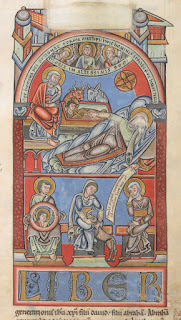
Nativity, with virgin and unicorn below, from Floreffe Bible, 12th century.
The Nativity of Christ,
from the Floreffe Bible, British Library,
Add MS 17738, fol. 168r

(ca. 1170, Belgium)
A Sermon for the Nativity of the Lord

From the Speculum Ecclesiae of Honorius Augustodunensis (early 12th cen.)[1]

Let the heavens be glad and let the earth rejoice! Let the mountains break into songs of praise, for the Lord has comforted his people and will have mercy on his poor (Ps 95[96].11 / Is 49.13).[2] It is right that the heavens are bid to be glad today, for today they have gained the illumination of new light and new joy. Today indeed heavens’ King has willed to visit the earth with his presence and to restore through humans the loss incurred in heaven by the angels’ fall.[3] So at once the heavens have shown their cheerful joy to the world by sending forth a shining star in honor for their King. It is also right to urge the earth to rejoice today, for the Truth that sprung up from the earth (Ps 84.12[85.11]) has come today to free her from the curse and to unite humankind, born from the earth, with the angels in heaven. The earth has made her great exultation known to the world today by pouring forth from her womb a spring of oil for her God, who is born from her bosom, and offering it to those who look in wonder [4] The mountains, too, are urged to break into song in praise of God.[5] The mountains are the patriarchs and prophets, who transcended human merits by their holy way of life like mountains that rose high above the plains of the earth. Today they have broken into song in praise of God, for what the patriarchs once foretold in figures and the prophets in Scripture, they rejoice today to see fulfilled—that the people of the Gentiles who walked in the darkness of ignorance have seen today the great light of God’s eternal Wisdom (Is 9.2). And on those who dwell in the land of the shadow of death—that is, hell—light has risen (Is 9.2): Christ is born, the splendor of the everlasting Father;[6] after coming down for them and snatching them from the darkness, he drew them towards eternal light.

Wednesday, December 25, 2013

O factura Dei (Symphonia R 405rb)

For Christmas, the Nativity of the Lord, a Verse on the Incarnation
by St. Hildegard of Bingen[1]


God enthroned upon
the mountain, with
Fear of the Lord (L)
& Poor in Spirit (R),
Scivias I.1.
Rupertsberg MS,
fol. 2r.
O factura Dei que es homo,
in magna sanctitate edificata es,
quia sancta divinitas
in humilitate celos penetravit.
O quam magna pietas est
quod in limo terre deitas claruit,    
et quod angeli Deo ministrantes
Deum in humanitate vident.
O what a work of God you are, O human,
forged and established in great holiness—
for now divinity most holy has
the heavens pierced in your humility.
How great indeed that loving kindness is,
as in the earthy clay the Godhead beamed,
the angels in their ministry to God
see now that God within humanity.

Tuesday, December 25, 2007

Puer Natus Est Nobis


Let us rejoice, for the Christ Child is born to us today!

We celebrate today the birth of Jesus Christ, the Immanuel, the Son of God; on this day some 2,000 years ago a virgin named Mary gave birth to Him, and wrapped in swaddling clothes he was lain in a manger. At the opening of the Midnight Mass in the Cathedral of St. Paul here in Münster, the cantor sang the announcement of the First Mass of Christmas taken from the Martyrologium Romanum, the medieval catalogue of the calendar of the Church’s feast days:

In the 5199th year of the creation of the world, from the time when in the beginning God created heaven and earth; from the flood, the 2957th year; from the birth of Abraham, the 2015th year; from Moses and the going-out of the people of Israel from Egypt, the 1510th year; from the anointing of David as king, the 1032nd year; in the 65th week according tothe prophecy of Daniel; in the 194th Olympiad; from the founding of the city of Rome, the 752nd year; in the 42nd year of the rule of Octavian Augustus, when the whole world was at peace, in the sixth age of the world: Jesus Christ, the eternal God and Son of the eternal Father, desiring to sanctify the world by His most merciful coming, having been conceived by the Holy Ghost, and nine months having passed since His conception was born in Bethlehem of Juda of the Virgin Mary, having become man. The Nativity of Our Lord Jesus Christ according to the flesh.

As tedious as it might seem to define the day of Christ’s birth according to many historical references, the Martyrologium has a very good reason for its lengthy detail: the birth of Jesus Christ, the official revelation to the world of the Incarnation, the Word, the only-begotten Son of God before all ages of the world, now born of a virgin in a stable in Bethlehem—this birth was and is an historical event. Christ was born a man on an actual day in the actual history of the world. The Nativity of Christ is not just a story in a religious text, like so many stories in so many traditions around the world; no, He was a completely real person, like you or I, acting in the reality of history.

The incredible beauty and yet radical statement that is the mystery of the Incarnation is at the heart not only of the Christian religion but also the very existence of the world. Christ is “God from God, Light from Light, True God from True God, begotten not made, being of one substance with the Father, by whom all things were made”: He is the very foundation of existence. Yet He also “for us men and for our salvation came down from Heaven: and was incarnate by the Holy Spirit of the Virgin Mary, and became man”: He was (and is) an individual human being, walking upon the earth in an actual body composed of muscles and sinews and blood. If He missed a nail and hit His finger with a hammer in His carpenter’s workshop in Nazareth, he felt the same pain that you or I feel when we do the same. Indeed, He faced even greater pains than you or I are likely ever to face when He was “crucified also for us under Pontius Pilate, suffered, and was buried.”

And as radical as this idea may seem, that the immortal, invisible, omniscient and omnipresent God, Creator of all that is and was and ever shall be, was also a simple woodworker from a backwater town on the Sea of Galilee; as radical as this idea may seem, more radical yet is “what both educated and simple people [find] in Christ: he tells us who man truly is and what a man must do in order to be truly human.” (Spe Salvi 6). Not only did Christ the God become Christ the Man, the King who was made Sacrifice, but in doing so, He both renewed and further exalted the very humanity that we hold in common with Him, as we are reminded during the Preparation of the Gifts in the Mass:

Deus, qui humanae substantiae dignitatem mirabiliter condidisti, et mirabilius reformasti: da nobis per huius aquae et vini mysterium, eius divinitatis esse consortes, qui humanitatis nostrae fieri dignatus est particeps, Iesus Christus.

O God, who didst wonderfully create, and yet more wonderfully renew the dignity of the nature of man: grant unto us, that through the mystery of this water and wine, we may be sharers in His divinity who vouchsafed to be made partaker of our humanity, Jesus Christ.

In the New Adam, the strength of humanity was made anew, perfected from the Fall of Adam but also excelling Adam even in his perfection; for though Adam was made in the image and likeness of God, yet God did not share with Adam yet his human nature. But now, in an act made out of His boundless love, His Son has taken up that nature, and in this mystery are opened unto us the true gates of righteousness. In Christ we may now share in the one divinity; Adam and Eve lusted after this, but it was not given them, for they knew not the mystery of the Son. But now, every one of us, every child who is born into the world just as was Christ 2,000 years ago, has received in His birth the opportunity to be co-heirs of the Kingdom of Heaven.

While this Mystery seems incomprehensible, it is yet the most accessible feature of the Christian religion, for in Christ we have been presented with a man, a simple man, a true person with whom we each can have a true, intimate, personal relationship. Christian spirituality is not an amorphous cloud; it is not some “feeling” that we have of joy or loftiness or nobility. It must not be confused with many modern ideas of spirituality that emphasize the temporal sensation or sentiment of some ill-defined “spiritual connection” to some higher being. No, Christian spirituality is concrete and is founded in the very personal, very real Person of Jesus. Without Jesus, without the Christ who was a real, historical, and finite man, and is also a real, eternal, infinite God, Christian spirituality is empty.

Furthermore, without this real encounter with the personhood of Christ, this whole life and world is left empty and dark, a mere wandering from a naked birth to a naked death. If one believes in no God, or even if one believes in a God who is but as the furthest twinkle of a star, beautiful perhaps but utterly distant and foreign, then there is left nothing in this world but the brief span of the insignificant life of a human, one of billions living but a snapshot of a world infinitely larger than any can comprehend. In the cold, materialistic worldview that knocks ever at the gates of one who despairs of the divine, life is nothing but “poor, nasty, brutish, and short,” as Hobbes noted centuries ago.

But to this dark and dreary emptiness we are not bound, for the world is neither accident nor meaninglessness, but the very essence of the love of a personal God. As Pope Benedict says in his recent encyclical, Spe Salvi:

It is not the elemental spirits of the universe, the laws of matter, which ultimately govern the world and mankind, but a personal God governs…the universe; it is not the laws of matter and of evolution that have the final say, but reason, will, love—a Person. And if we know this Person and he knows us, then truly the inexorable power of material elements no longer has the last word; we are not slaves of the universe and of its laws, we are free. In ancient times, honest enquiring minds were aware of this. Heaven is not empty. Life is not a simple product of laws and the randomness of matter, but within everything and at the same time above everything, there is a personal will, there is a Spirit who in Jesus has revealed himself as Love. (Spe Salvi 5)

Finally, as we look today upon the Incarnate Christ as an example of “who man truly is and what a man must do in order to be truly human,” we must realize that we are gazing this happy day upon a child lying in a manger, the food trough of farm animals, sheltered from the elements by a barn, “because there was no room for them at the inn.” (Luke 2:7); and though the Magi brought to Him the gold of Kingship and the frankincense of Divinity, these gifts acknowledged not His human destiny but His spiritual reality. Indeed, it was Balthazar’s gift of myrrh that spoke most clearly of the role that this man of the royal house of David was to play in human history: His sacrificial death. The truth of humanity’s lot in this world is not the gold of the king but the pain and sorrow of suffering. Yet the suffering that we see all around us every day is not the meaningless horror that it would seem, for all suffering finds it true meaning in the suffering of Him who should not have had to suffer at all, but yet suffered more than all.

The key to our humanity as revealed to us by the lowly babe in a manger is His humility. He is the Son of God, and yet he slept not on silk but straw; He is the Word by which all is made, and yet spoke not of his right to rule the world but of his choice to serve it; He is of the great “I AM” who commanded Moses to remove his sandals upon holy ground, and who yet Himself removed the sandals of others to wash their feet. A man must serve and not be served in order to be fully human. A man must lay himself down in order to be stood aright not by his own will by the will of God. Above all, a man must so love God and his neighbor that even death for them is but a pittance compared to this love.

If this sounds difficult or even impossible for the lost, wandering, selfish, poor being that is man, remember but this: “Unto you is born this day in the city of David a Saviour, which is Christ the Lord.” (Luke 2:11)

Gloria in excelsis Deo, et in terra pax hominibus bonae voluntatis!

Sunday, December 23, 2007

Christmastime in Münster

A little over a week ago, freezing temperatures finally came to this city. Yet, it does not snow in Münster, though I’m not particularly sure why; instead, we have awoken each morning to a very heavy frost. Though the day may not end under a heavy fog, each morning almost invariably dawns beneath it, and as the air becomes colder, this mist clings to all in a crystalline coat. The sun might (or might not, as today) burn through it ere the noon bells ring, and sometimes (as I painfully discovered this morning), the blanket lies invisibly (and slickly) upon the sidewalks and pavement (a phenomenon called Glatteis, safety from which the celebrant wished us at the opening of this morning’s Mass). Drivers must scrape off their cars in the morning, while the grass (which has remained yet green, though rather the dark and toughened hue of the end of the season than the bright and vibrant color of its youth) is cloaked, and as one walks about, it shimmers dully between frosty white and dark green. The frost’s most magnificent vesture is, however, worn by the bare branches of the trees, covered in an icy film that grows ever thicker as the nights grow colder. When the skies of day are still overhung with the chilled and dreamy mists, the thin limbs of the trees slice through it with their cold filigree of silver; but when the darts of brilliant sunlight strike forth, oblique and always low on the horizon in these days, the branches glow with pale, white gold; but alas, it lasts only a short time, for soon they are reduced to the muddied browns and greys of wetted wood, the frost melted by the very rays that had illumined it.

Despite the deepening cold, however, the city’s most vibrant Christmas tradition has thronged apace: the Weihnachtsmarkt, or Christmas market. This tradition, found in towns great and small throughout Germany (the most famous is to be found in the great square of Nürnberg), came brilliantly to life in Münster at the beginning of Advent, and as the Day of Jubilee has drawn nearer, the booths have thronged ever more with jollity and merriment (and on the weekends, the whole of the markets are packed to overflowing with the Dutch, who come by the busload—it would seem that Amsterdam can’t match Münster for the holiday cheer). Because Münster’s greatest open space in the old city, the Domplatz (Cathedral Square) is reserved for the use of the great traveling market that comes every Wednesday and Friday year-round, the Weihnachtsmarkt has been shoehorned into little squares and courtyards throughout, so that one can walk from the Aegidiiplatz in the south to the Lambertikirche in the north, wending one’s way from one grouping of booths to the next.

Some of the booths offer various Christmas trinkets (from little wooden ornaments to various Santa hats—particularly popular this year seems to be the one that comes with two white braids hanging from it, in the style of Pippi Longstocking), but many are run by craftsmen offering various handcrafts in wood, ceramic, glass, or other materials. As numerous as the crafts, however, is the ubiquitous drink of the Weihnachtsmarkt: Glühwein, or spiced and mulled wine, a steaming drink to return warmth to the belly among the frigid mists of winter; and, of course, the many vittles offered to the crowds: the traditional (at least these days in northern Germany) Currywurst (sliced Bratwurst smothered in warm curry ketchup), and Pommes (French fries), with your choice of curry ketchup or Mayo (pronounced “my-oh” here) slathered on top; and for the sweet tooth, the Christmas confections of Lebkuchen (soft, spiced gingerbread) and gebrannte Mandeln (almonds “roasted” or caramelized in sugar with vanilla and cinnamon). Finally, strung throughout one will find musicians of all types (from adolescents with their flutes and clarinets trying to make some extra spending money, to the old hats who do this for a living) adding that final touch of Christmas cheer.

The street performers were not the only musical cheer that I have experienced this season in Münster. In my time over the last few years in Boston, I started to make it a tradition as a birthday present to attend a performance of Handel’s Messiah on or about my birthday (December 2), as the Handel & Haydn Society of Boston performs it several times annually on the first few weekends of December. Sometime in November, my grandmother asked me if I was going to continue the tradition, and I had to reply that alas, I would not, as I was unaware of any performances of the Messiah in Münster. But about a week before Thanksgiving, as I was glancing through a pamphlet at the Cathedral listing the various musical offerings around town for the Christmas season, lo and behold, I discovered that there would, in fact, be a performance of the aforesaid masterwork at the Apostelkirche (the main Protestant church in the city’s center, housed in a beautiful gothic structure that was once a Dominican parish before being confiscated during the secularization at the beginning of the 19th century; when it was finally to be returned to religious hands, the Dominicans no longer had a stake for it and it, therefore, given as the first house of worship for Lutherans in this (still) predominantly Catholic town); furthermore, only two performances were to be offered, on the evenings of Saturday and Sunday, December 1 & 2 (and as I later discovered, it is by no means an annual performance; the last time it was performed was 1995!). Much to my delight, I rounded up my American friends here (Timon, who lives in my dorm complex, and David, both Americans studying at the university, and Jennifer and Jörg Burkart and Bill Hoye) and held a “birthday outing” on the evening of the second. Not only was I able to continue the nascent tradition, but I have now christened it a firm part of my birthday celebrations, for it has been followed not only in America but in Germany, too! The evening was, however, to have its own German twists: the oratorio was sung in German (not my accustomed English), and we headed to the Weihnachtsmarkt afterward for a nice round of Glühwein. The performance was overall good, though the trumpeter had a few missteps early on, but recovered well for his standout role in the latter third of the piece; and, unfortunately, they cut a few sections out for length, including “O death, where is they sting?”, a beautiful duet toward the end. But in the company of friends on the occasion of a birthday celebration, such deficiencies are easily overlooked.

Last week, on the third Sunday of Advent, I enjoyed another musical celebration of the season heralding Our Lord’s Birth, this time in the company of the Deutsch-Amerikanische Gesellshaft (the German-American Society of Münster). The afternoon began with an Advent Tea hosted by Heidi Wegmann at her beautiful home in Wolbeck, a southeastern suburb of the city. From there, as night descended (this far north, that begins at about 4:00 in the afternoon), we journeyed to the workshop of Friedrich Fleiter, Orgelbaumeister, whose family has specialized in the construction, maintenance, and repair of organs since 1872, to attend a concert benefiting a local charity, given annually on the Wurlitzer organ installed in the workshop. The organ, a “Hope-Jones Unit Orchestra, Made by the Rudolph Wurlitzer Co., Cincinnati”, was originally installed in a Hollywood movie theater in 1924. When the theater was renovated to be able to show movies with sound in the 1940’s, the organ was moved to a stage theater, also in Hollywood, where it remained until that theater closed in 1994, at which time Herr Fleiter’s company saved it from the trash heap and brought it to Münster. Designed to reproduce a full orchestra pit to accompany silent films, the organ has such ranks as a xylophone, snare drums, bells, and a cymbal. Befitting the Wurlitzer’s American origins, the concert began with a series of American pop songs from the 1950s – ‘70s, including “It’s My Party and I’ll Cry if I Want To” and “Downtown” (I’ll admit, it was a bit odd to hear them on an organ, but fun nonetheless). This was followed by a screening from DVD of a silent Laurel & Hardy short, which the organist accompanied most excellently. The film, called “Big Business”, tells the story of Laurel and Hardy the Hollywood Christmas tree salesmen and their over-the-top exploits selling pine trees door-to-door on the balmy back lot. After an intermission (accompanied by a nice mug of Glühwein), the concert concluded with a great series of American Christmas songs (both traditional and popular).

Of course, all of these wonderful festivities have been but in preparation for the truly miraculous feast that commences tomorrow night: the Birth of Our Saviour, Jesus Christ. As we gather at midnight in the Cathedral to celebrate the coming of the Emmanuel, the God-with-us, to dance upon the dancing day for our True Love, we shall experience the fulfillment of all our expectant watching. The lamps of the Advent wreath have been lit, and await the Bridegroom’s march, as proclaimed to us by the watchmen on the heights. Then, no matter whether the mists continue to shroud the night or the stars twinkle and the moon sets to sparkling the frost-encrusted tangles of the hedges, the True Light, God’s Son, shall shine forth the brighter in our hearts.

Wednesday, December 06, 2006

De Nomine Festi Nativitatis Domini: Christi Missa

In three short weeks, that day will come again when little children will excitedly clamber out of their beds on Christmas Day, the sugar canes dancing in their dreams replaced by the genuine articles pouring out of their stockings, accompanied by their shouts of glee to see what Santa has brought them this year.

As we lead up to that happy morn, we are once again faced with the unfortunate tendencies of modern political correctness to sterilize that day of any religious meaning. It’s no longer to be a “Merry Christmas,” but merely a “Happy Holidays,” and the presents Santa has stashed will no longer lie beneath a “Christmas” tree, but only under a “Holiday” one. Once again, we would like to register our disappointment that our society feels the need to cleanse this day of cheer and glad tidings with bland titles expressive of anything but the true joy that only Christmas can bring.

Indeed, Christmas, the day on which we commemorate the sublime day of Christ’s noble birth, is a day of hope and joy for all mankind. It is sad that secularists are so frightened by the Christian message that they feel compelled to deny it even in its most inclusive and hopeful season.

The Christmas message is simple: on this day, a child was born in Bethlehem, a child whose only mission was to love and cherish every single human being to ever walk this good earth. This is no message to frighten: it is a message to comfort even the loneliest heart, the most sorrowful soul. It is a message of purest joy, given to every man and woman, to young and old, of all creeds, of all colors, of all orientations.

Come, friends, let us rejoice and be glad; let us remind each other of this greatest gift ever given; let us call out to each other a hearty “Merry Christmas,” regardless of our own creed, for the cheerful day on which the Prince of Peace brought peace to all men of every creed.

Monday, December 04, 2006

In Tempore Adventus Domini: Preparing for the Christ Mass

The Christmas decorations went up fast this year; in fact, the Christmas wreath on the Dustbowl corner of McElroy was hung before Thanksgiving (it seems now that Christmas starts sometime in November). The lights are burning on the trees, the boughs tied to the railings of the staircase, and finally, we woke up to snow yesterday morning (though it was so very short lived).

But something has gotten lost in this hubbub and humming of “Rockin’ Around the Christmas Tree”. Now, we’re not ones to tread on the Christmas spirit of others, but for many people, that Christmas spirit seems to have neglected a very key component, that the season of Christmas (which actually begins on the evening of December 24th) is preceded by the season of Advent.

What modern society seems to celebrate as “Christmas” is actually the time of preparation for the coming of Christ in the one Mass of the year specially named for Him. Advent is a time for recollection and renewal, a time to turn inwards and to examine ourselves in the light of the oncoming Incarnation.

Although the incomparable joy that awaits us on Christmas day is omnipresent, we nevertheless are called in these four weeks to look back at our lives, both now and over the past year, to see in what ways we have succeeded and in what ways we have failed to live out the promises of the Incarnation in our everyday lives. We joyously look to the glory of the Lord prophesied by Isaiah, but we must equally be mindful of the gross darkness of sin that covers us, the black pitch of iniquity from which the coming of the Lord of Hosts is to free us.

Let us attend, therefore, to the voice of one crying out in the wilderness, “Prepare ye the way of the Lord!” For indeed, as John preached the baptism of repentance for the remission of sins, so it is for that reason that the virgin conceived and bore a son whose name is Emmanuel. Let us reflect on the words of Isaiah, who tells us, “For Jerusalem is ruined, and Judah is fallen: because their tongue and their doings are against the Lord, to provoke the eyes of his glory. The shew of their countenance doth witness against them; and they declare their sin as Sodom they hide it not. Woe unto their soul! for they have rewarded evil unto themselves.” (Is. 3:8-9) He seems especially to have been talking to BC students when he said, “Woe unto them that rise up early in the morning, that they may follow strong drink; that continue until night, till wine inflame them! ...but they regard not the work of the LORD, neither consider the operation of his hands.” (Is. 5:11-12)

But even as we recognize the sin into which we have fallen, let us not lose sight of the pivotal and eternal mystery of God’s intervention into human history, “for unto us a child is born, unto us a son is given…and his name shall be called Wonderful, Counsellor, The mighty God, The everlasting Father, the Prince of Peace.”