
About Me

My photo
I am a medievalist, a social studies teacher at Knox Central High School, and an adjunct instructor in history at Union Commonwealth University. My research includes medieval theologies of history, text/image relationships in visionary and mystical texts, and the writings of the twelfth-century Doctor of the Church, St. Hildegard of Bingen. I am also a translator of medieval Latin and German texts, especially as relate to my research. My translation of Hildegard's Book of Divine Works is available from Catholic University of America Press here. I completed a Master's in Medieval Studies at the University of Notre Dame in 2010, a Fulbright Fellowship in Germany in 2008, and a B.A. in Classics and German at Boston College in 2007.
Showing posts with label Speculum Ecclesiae. Show all posts

Saturday, December 25, 2021

“Let the heavens be glad and let the earth rejoice!” (Ps 95[96].11)

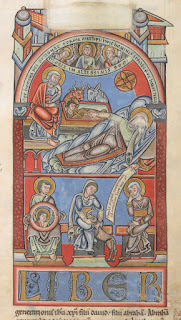
Nativity, with virgin and unicorn below, from Floreffe Bible, 12th century.
The Nativity of Christ,
from the Floreffe Bible, British Library,
Add MS 17738, fol. 168r

(ca. 1170, Belgium)
A Sermon for the Nativity of the Lord

From the Speculum Ecclesiae of Honorius Augustodunensis (early 12th cen.)[1]

Let the heavens be glad and let the earth rejoice! Let the mountains break into songs of praise, for the Lord has comforted his people and will have mercy on his poor (Ps 95[96].11 / Is 49.13).[2] It is right that the heavens are bid to be glad today, for today they have gained the illumination of new light and new joy. Today indeed heavens’ King has willed to visit the earth with his presence and to restore through humans the loss incurred in heaven by the angels’ fall.[3] So at once the heavens have shown their cheerful joy to the world by sending forth a shining star in honor for their King. It is also right to urge the earth to rejoice today, for the Truth that sprung up from the earth (Ps 84.12[85.11]) has come today to free her from the curse and to unite humankind, born from the earth, with the angels in heaven. The earth has made her great exultation known to the world today by pouring forth from her womb a spring of oil for her God, who is born from her bosom, and offering it to those who look in wonder [4] The mountains, too, are urged to break into song in praise of God.[5] The mountains are the patriarchs and prophets, who transcended human merits by their holy way of life like mountains that rose high above the plains of the earth. Today they have broken into song in praise of God, for what the patriarchs once foretold in figures and the prophets in Scripture, they rejoice today to see fulfilled—that the people of the Gentiles who walked in the darkness of ignorance have seen today the great light of God’s eternal Wisdom (Is 9.2). And on those who dwell in the land of the shadow of death—that is, hell—light has risen (Is 9.2): Christ is born, the splendor of the everlasting Father;[6] after coming down for them and snatching them from the darkness, he drew them towards eternal light.

Sunday, May 31, 2020

“By the word of the Lord the heavens were established, and all their power by the spirit of his mouth.” (Ps 32[33].6)

A Sermon for Pentecost
Pentecost
From British Library, MS Egerton 809, fol. 35v
(Gospel Lectionary, early 12th cen., Germany)

From the Speculum Ecclesiae of Honorius Augustodunensis (early 12th-cen.)[1]

By the word of the Lord the heavens were established, and all their power by the spirit of his mouth (Ps 32[33].6).[2] Through the Son, who is the Word of God, not only the heavens but all things were created from nothing, and so that they would not be again melted into nothing, they were confirmed by that same Word and all their power furnished by the spirit of his mouth. The angels, too, are called “heavens” who, when the others fell, were confirmed in divine love through the Word and decked out by his spirit with all power.[3] So it is written, The Spirit of God has adorned the heavens (Job 26.13), for he graced both the heavens with the stars and the angels with the virtues.

Thursday, May 21, 2020

“The sun was lifted up, and the moon stood fixed in its order.” (Hbk 3.11)

The Ascension of Christ
13th-c. apse window, Lyons Cathedral
(Image: Wikipedia)

A Sermon for the Ascension of the Lord

From the Speculum Ecclesiae of Honorius Augustodunensis (early 12th cen.)[1]

The sun was lifted up, and the moon stood fixed in its order (Hbk 3.11).[2] Christ is the eternal sun, by which all the angels’ choirs are enlightened; he is the true light, by which all souls are enlightened (Jn 1.9). While hidden here beneath the cloud of the flesh, he is surrounded by the gloom of our fragility—but at last he surfaced from the darkness of hell and today is lifted gloriously up above the stars and exalted above all the angels’ dignities, the Lord of Majesty at the right hand of the Father. The moon or Church, enlightened by him, stood fixed in her order,[3] as with the apostles she watched him ascend the heavens. The apostles indeed formed the Church’s order as they established for her the order of living rightly and instructed her in how to direct her course according to the Sun of righteousness (Mal 4.6). O how splendid these horns the newborn moon has extended today, as the sun rising high poured into it the brilliance of eternal splendor! O how clear her visage, as she stood fixed in her order, watching with the apostolic choir—who formed her order—and with the Virgin Mother of God—who served as her type—as her flesh penetrated the outer heavens with her head, that is, with her Redeemer, with her Bridegroom, with her God! O what happiness mounts up today in heaven for the angels, as the Son of God, who was directed from the palace to the prison on behalf of a servant—indeed from his homeland into exile, an exile on behalf of an exile—as he returns today triumphantly to the Father’s kingdom! So too this is called the day of God’s triumph, when the singular Conqueror of death is glorified as the Author of life with hymns of praise by the Senate of the heavenly Court.

Sunday, April 12, 2020

“This is the day that the Lord has made!”

Opening of the sermon De Paschali Die,
from Oxford, Bodleian Library,
MS Lyell 56, fol. 58v.

A Sermon for Easter Day

From the Speculum Ecclesiae of Honorius Augustodunensis (early 12th cen.)[1]

This is the day that the Lord has made: let us rejoice and be glad in it! (Ps 117[118].24) Dear friends, the Lord has made all days in his majesty, but this one he chose in his loving kindness before all of them, as a joy for both angels and humans. Indeed, the night of death and pain that began with Adam’s sin and keeps all things wrapped in its gloom—this holy night has brought it to an end. And today began the day of happiness and joy that will have no evening. The entire course of time from Adam until Christ was called the day of death, in which every person was led at death into hell. But this time is called the day of life and resurrection—it begins when Christ is declared to have risen again with many; and when it ends, there is no doubt that the whole human[2] race will be raised again on that very same day. In that day indeed, that time of grace, the elect who have been withdrawn from the flesh soon shall enter the joy of the Lord (Mt 25.21); but when the last resurrection has been accomplished, they shall possess double in their land (Is 61.7), when they rejoice everlastingly in body together with the soul at the Lord’s good things.