About Me

My photo
I am a medievalist, a social studies teacher at Knox Central High School, and an adjunct instructor in history at Union Commonwealth University. My research includes medieval theologies of history, text/image relationships in visionary and mystical texts, and the writings of the twelfth-century Doctor of the Church, St. Hildegard of Bingen. I am also a translator of medieval Latin and German texts, especially as relate to my research. My translation of Hildegard's Book of Divine Works is available from Catholic University of America Press here. I completed a Master's in Medieval Studies at the University of Notre Dame in 2010, a Fulbright Fellowship in Germany in 2008, and a B.A. in Classics and German at Boston College in 2007.
Showing posts with label Hildegard of Bingen. Show all posts

Wednesday, September 17, 2025

Operatrix in vinea Domini: A Chronogram for the Feast of St. Hildegard

Vineyards at the
Abbey of St. Hildegard,
Eibingen, Germany.
operatrIX In VInea DoMInI,
eXhortes nos
IgnaVa et obsCVra peCtora eXCItare
et VIrtVtIbVs CLarIbVs operare.

Worker in the vineyard of the Lord,
may you urge us
to stir up our sluggish and darkened hearts
and to act with virtues shining bright.

Tuesday, September 17, 2024

O soror Sapientiae: A Chronogram for the Feast of St. Hildegard of Bingen

Wisdom
From the Stammheim Missal, fol. 11;
Getty Museum, Ms. 64 (97.MG.21))
o soror sapIentIae,
eLeCta et ereCta
Ita qVoD oMnes CreatVrae
per te ornatae sVnt:
nos VIrtVtIbVs fVLgentIbVs LargIter renoVarI
In VIsIonIbVs tVIs horterIs.

O wisdom’s sister,
chosen and upraised
so that all creation
has been graced by you:
in your visions you call on us
to be bountifully renewed with gleaming virtues.

Sunday, September 17, 2023

O virgo visionibus fulgens: A Chronogram for the Feast of St. Hildegard of Bingen

Humility; detail from the
Pillar of the Savior's Humanity,
Scivias 3.8
(Rupertsberg MS, fol. 178r)
o VIrgo VIsIonIbVs fVLgens,
qVIbVs VIrgo DeI genetrIX
et eCCLesIa sponsa eIVs
VIae sanCtItatIs reVeLantVr:
ora pro nobIs In ItInere nostra,
Vt VIrtVtes CaeLestes
qVasI tVrres CorVsCantes
In nobIs aeDIfICentVr.

O virgin, gleaming with visions,
in which the Virgin Mother of God
and the Church, His spouse,
are revealed as pathways of holiness:
pray for us on our journey,
that the heavenly virtues
like sparkling towers
might be built up within us.

Wednesday, March 29, 2023

New Article: “O Jewel Resplendent”: The Virgin Mary and Her Analogues in Hildegard of Bingen’s Scivias

Now published in Religions 14:3 (2023), 342 (21pp), as part of a Special Issue on “The Virgin Mary in the Middle Ages and the Renaissance: Devotion and Iconography.” DOI: https://doi.org/10.3390/rel14030342.

Abstract

Despite the lush visual imagery of the twenty-six visions that form the foundation of Hildegard of Bingen’s first work, Scivias, the physical person of the Virgin Mary appears only once, as the Queen of the heavenly symphony in the book’s final vision. The images that coalesce in the musical compositions dedicated to the Virgin in that final symphony, however, resonate throughout the rest of the work, revealing Mary’s constant background presence. Moreover, analogues of traditional Marian imagery in both the text and the illustrations Hildegard designed for the work allow us to see how the Virgin exemplifies the life of the virtues from which Hildegard constructs the City of God. Finally, connections between Scivias and Hildegard’s third work, Liber diuinorum operum, demonstrate that the Virgin Mary models the path of virginity that Hildegard holds up as the singular road to holy perfection for herself and the nuns under her care.

Friday, August 19, 2022

"Sexual Abuse and the Shadows of the Fall"

In this new essay published today at The Church Life Journal, I look at St. Hildegard of Bingen's views on the origins of sexual abuse and the universal #MeToo moment. She notices precisely the ways in which the abuse of power distorts our ability to know and understand reality, and thus distorts our relationships with each other and with God. Her solution lies in the redemption of human nature through Christ's humility.

Friday, April 22, 2022

“Hildegard of Bingen’s Lament for the Environmental Crisis Caused by Human Sin”


For Earth Day, I've got an extended look at the integrated ecological vision of St. Hildegard of Bingen up over at the Church Life Journal of the McGrath Institute for Church Life at the University of Notre Dame--check it out!

Monday, November 01, 2021

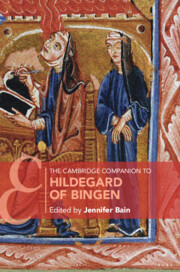
Now published: “Picturing Hildegard of Bingen’s Sight” in The Cambridge Companion to Hildegard of Bingen

Nathaniel M. Campbell, “Picturing Hildegard of Bingen’s Sight: Illuminating Her Visions.” Ch. 12 in The Cambridge Companion to Hildegard of Bingen, ed. Jennifer Bain. Cambridge University Press, 2021, pp. 257-279; access online here.

Summary

This chapter explores the development and purpose of the illustrations in two manuscripts of Hildegard of Bingen’s works: one designed by Hildegard (the Rupertsberg Scivias), the other designed by a later generation of her monastery’s nuns (the Lucca Liber divinorum operum). An overview of her visionary experiences demonstrates the prophetic mission of their detailed images to communicate theological truths. I argue that Hildegard designed the Scivias images to aid that communication and provide visual exegesis of her visions, serving as a teaching tool to guide the reader through the manuscript. The next generation of nuns followed Hildegard’s impulse to illustrate her visions with the later Liber divinorum operum manuscript, but its famous cosmological diagram diverges from the text because the designer did not understand its meaning. The chapter closes with an assessment of the very limited influence of Hildegard’s illustrations in the later Middle Ages, with one story from the preaching of Johannes Tauler demonstrating their liability to reinterpretation.

Friday, September 17, 2021

O hortulana sapiens: A Chronogram for the Feast of St. Hildegard of Bingen

A statue of St. Hildegard in a garden
A statue of St. Hildegard in a garden.
Source: The Abbey of the St. Hildegard.
o hortVLana sapIens,
VIsIones tVae Verba VtILIa
sICVt herbas bonas
nobIs proferVnt:
ora pro frVCtVosItate nostra,
Vt oDor VIrtVtVM
a spIrItV sanCto qVasI a faVo pVro effVsVs
In nobIs InVenIatVr.

O gifted gardener,
your visions bring forth
helpful words for us
like wholesome herbs:
pray for our fruitfulness,
that the aroma of the virtues,
poured forth by the Holy Spirit as from a crystal honeycomb,
might be found within us.

Monday, November 09, 2020

St. Hildegard of Bingen on the Interconnectedness of Creation

I gave the following talk as part of the 2020 “St. Hildegard Speaks” virtual pilgrimage in September:

You can find my translation of Hildegard’s Book of Divine Works from The Catholic University of America Press here or on Amazon here.

You can find the 2020 Chronogram from the end of the talk here.

Thursday, September 17, 2020

O luce viventi coronata: A Chronogram for the Feast of St. Hildegard of Bingen

Hildegard beholds the universe.
Liber Divinorum Operum 1.4
(detail from Lucca, MS 1942, fol. 38r)
o LVCe VIVentI Coronata,
CVIVs VoX qVasI tonItrVI
nos De LangVore nostro
In saLVteM roborat:
ora pro nobIs
et pro aegra orbIs aetate nostrI.

O one crowned with the Living Light,
whose voice as of thunder
strengthens us from our weakness
into health:
pray for us
and for this ailing age of our world.

Tuesday, September 17, 2019

Spiritui Sancto honor sit: A Chronogram for the Feast of St. Hildegard

Human microcosm enmeshed by clouds.
Liber Divinorum Operum 1.3
(detail from Lucca, MS 1942, fol. 28v)
spIrItVI sanCto honor sIt,
qVI In opere hILDegarDIs VIrgInIs
stVDIa saLVtarIa
VeLVt nVbes In aVrIs pVrIs nItentes
nobIs CoLLegIt.

Honor be to the Holy Spirit,
who in the work of the virgin Hildegard
has gathered for us
studies in saving health
like clouds gleaming in the clear sky.

Wednesday, April 10, 2019

New Article: “The prophetess and the pope: St. Hildegard of Bingen, Pope Benedict XVI, and prophetic visions of church reform”

Nathaniel M. Campbell, “The prophetess and the pope: St. Hildegard of Bingen, Pope Benedict XVI, and prophetic visions of church reform,” postmedieval: a journal of medieval cultural studies 10.1 (2019), 22-35; read online for free here.

Just published in a special issue devoted to “Prophetic Futures,” this article explores the affinities between St. Hildegard of Bingen and Pope Benedict XVI that may have led him to canonize her and declare her a Doctor of the Church in 2012. It pays special attention to their views on the Church’s prophetic mission and prophecy’s role in reforming it.

Abstract

Monday, October 29, 2018

Now Published: St. Hildegard of Bingen’s The Book of Divine Works

I am pleased to announce that my translation of The Book of Divine Works by St. Hildegard of Bingen is now available from The Catholic University of America Press. This is the first time that the Visionary Doctor’s final and most important visionary work has been issued in a complete and scholarly English translation. The volume includes:

  • a Select Bibliography, with editions and translations of Hildegard’s works and secondary scholarship;
  • a 22-page Introduction;
  • black-and-white reproductions of the ten famous illustrations for the work from the thirteenth-century Lucca manuscript (online color gallery here);
  • extensive explanatory notes and references to Scripture, Hildegard’s corpus, and other works of the Christian tradition;
  • special indices of Scriptural citations (with exegetical passages marked in bold) and References to Hildegard’s Works.

You can get it directly from CUA Press here; through through Amazon here; European distribution can be accessed here, or email here.

I’ve been working on this project for nearly five years now. My oldest son was born at its beginnings, and my wife’s patience has been tested throughout. I owe my whole family the deepest debt of gratitude and reparations for its burden. Friends, too, have provided invaluable support, especially in accessing research materials unavailable to me. To all those who have helped: a big thank you!

Monday, September 17, 2018

O vas speculativum: A Chronogram for the Feast of St. Hildegard

St. Hildegard of Bingen recording her visions
in the Liber Divinorum Operum (I.1),
from Lucca, MS 1942, fol. 1.
o Vas speCVLatIVVM
LVCIs VIVentIs:
praesta nobIs opVs DeI
In VerbIs et sIgnIs tVIs raCIonaLIbVs.

O mirroring vessel
of the Living Light:
set before us the Work of God
with your reasoned words and signs.

Friday, December 15, 2017

Article Published: The Authorship and Function of the Chapter Summaries to Hildegard of Bingen’s Liber diuinorum operum (JMLat 27)

Campbell, Nathaniel M. “The Authorship and Function of the Chapter Summaries to Hildegard of Bingen’s Liber diuinorum operum.” The Journal of Medieval Latin 27 (2017), pp. 69-106.

DOI: https://doi.org/10.1484/J.JML.5.114589

Also accessible online through academia.edu here.

          Abstract

Sunday, September 17, 2017

O Sibylla vera Rhenensis: A Chronogram for the Feast of St. Hildegard of Bingen

St. Hildegard of Bingen recording her visions
in the Liber Divinorum Operum (I.1),
from Lucca, MS 1942, fol. 1.
o sIbyLLa Vera rhenensIs
VerbIs LVCIs VIVentIs CorVsCans,
VIrtVte tVa eXpLICa
qVare nos CarItate
qVasI tVnICa DIVInItatIs InDVtos
opVs IpsIVs
In ItInere aeqVo
perfICere oportet.

O true Sibyl of the Rhine,
shimmering with the words of the Living Light,
by your virtue set forth
how we, clothed with love
as with the tunic of Divinity,
are to achieve
its work
upon the even way.

Saturday, September 17, 2016

O vox nunc in caelo: A Chronogram for the Feast of St. Hildegard of Bingen

St. Hildegard of Bingen (1098-1179).
Detail from painting by Cynthia Large.
o VoX nVnC In CaeLo
CantICa sonans sVperna,
sVper qVae anIMae nostrae
VeLVt pennae VoLant:
ora In obtVtV tVo pro nobIs,
Vt VIrtVs ChrIstI
qVasI CantICI noVI
In VIrga fLorentIs
nos VIrentes roboret.

O voice that echoes now
celestial songs in heaven,
on which our souls
as feathers fly,
in your beholding pray for us,
that the power of Christ
as of the New Song
that blooms upon the branch
might strengthen us as we flourish.

Thursday, September 17, 2015

O vox praeclara: A Chronogram for the Feast of St. Hildegard of Bingen

St. Hildegard of Bingen (1098-1179)
Stained-glass window (restored),
Rochuskapelle / Museum am Strom.
o VoX praeCLara,
VIDens In LVCe VIVente:
praeCepta DeI
nobIs persones,
Vt opera eIVs VIrIDa
In nobIs fLoreantVr.

(O vox praeclara, videns in luce vivente: praecepta Dei nobis persones, ut opera eius virida in nobis floreantur.)

(O illustrious voice, seeing within the Living Light: ring out for us the precepts of God, so that his verdant works might flourish within us.)

Monday, September 29, 2014

Hildegard of Bingen Studies and this Blog

St. Hildegard of Bingen recording her
visions in the Liber Divinorum Operum
(I.1), from Lucca, MS 1942, fol. 1.
Over the last year or two, this blog has served as an outlet for my ongoing work with the Visionary Doctor, St. Hildegard of Bingen, with a focus on two particular areas: her musical compositions in the Symphonia; and the last and greatest volume of her visionary trilogy, the Liber Divinorum Operum. I am pleased to announce that both of these areas have made the transition from personal blog to professional editions:
  • I have collaborated with two musicologists to begin publishing a complete online edition of Hildegard’s Symphonia under the auspices of the International Society of Hildegard von Bingen Studies. So far, we have made 18 of Hildegard’s compositions available, with Latin text, my new translations, musical transcriptions by Beverly Lomer, extensive commentary, and additional resources; and we are looking to add at least one new entry a week until we have completed the entire span of the Symphonia.
  • The Catholic University of America Press has agreed to publish my new translation of Hildegard’s Liber Divinorum Operum (“Book of Divine Works”) in their Fathers of the Church, Medieval Continuation Series. This will be the first time that Hildegard’s magnum opus will be published in a complete, scholarly English edition; the volume should appear in 2016.

Unfortunately, as a result of the time commitment required to complete these two projects, in addition to my part-time teaching responsibilities and caring for my infant son while my wife teaches full-time, I will have to step back from making regular posts to this blog. Those of you who have been following my Symphonia series will, however, be able to see its completion through the ISHBS’s project (and I may cross-post occasional updates to that project here); and those who have enjoyed my translations of the LDO can look forward to its complete appearance in a few years.

     Update, April 15, 2015:

My article, “‘Lest He Should Come Unforeseen’: The Antichrist Cycle in the Hortus Deliciarum,” has just been published in Gesta, Vol. 54, No. 1 (2015), pp. 85-118, and can be accessed online here. Gesta is the journal of the International Center of Medieval Art.

Wednesday, September 17, 2014

O prophetissa teutonica: A Chronogram in Honor of St. Hildegard of Bingen

Portrait of St. Hildegard.
Rupertsberg Scivias, fol. 1r
(Protestificatio)
o prophetIssa teVtonICa
et DoCtrIX beata eCCLesIae,
VIsIones tVae nobIs
VIrtVtes VIrIDItatIs
In VIa Vera ostenDant.

(O prophetissa teutonica et Doctrix beata Ecclesiae, visiones tuae nobis virtutes viriditatis in via vera ostendant.)

(O German prophetess and blessed Teacher of the Church, may your visions reveal to us the virtues of viridity upon the true way.)